

What is Zcash?
Zcash is a cryptocurrency built specifically around privacy. By default, the majority of blockchains, including Bitcoin, are completely transparent. Anyone can view every wallet balance and transaction ever made. Zcash does the opposite. It allows users to send and keep money without disclosing the amount, sender, or destination while yet enabling the network to confirm the transaction's legitimacy through a type of encryption known as zero-knowledge proofs. Users have the option to transact openly if they wish to prove something to a business partner or regulator, or privately through what are known as shielded pools. The entire purpose of Zcash is to provide optional privacy that can be proven when necessary and concealed when not. This is precisely what was at stake when the bug in this story came to light.
A Rally Built On A Real Thesis
While the rest of the cryptocurrency industry debated ETFs and layer 2s, Zcash spent the majority of 2024 and 2025 as an afterthought, trading close to $20. It surpassed Monero to become the biggest privacy currency by market capitalization by May 2026, when it had reached $642, a rise of more than 3,000%. That action was not just mere speculation. The share of supply stored in shielded, privacy-protected addresses increased from roughly 8% to 30% after the November 2024 halving, and Tushar Jain of Multicoin Capital revealed a stance in May that he described as "a return to the cypherpunk ideals crypto was founded on”.
Grayscale submitted a request to transform its Zcash Trust into the first spot privacy currency ETF in the United States. Zcash appeared to be the cleanest cryptocurrency recovery story for a few weeks.
The Bug
As part of an audit for the nonprofit Shielded Labs, security researcher Taylor Hornby discovered a serious vulnerability in Orchard, the cryptographic circuit that powers Zcash's newest and most private shielded pool. This occured on May 29 while he was working with Anthropic's Claude Opus 4.8. Since Orchard's May 2022 launch, the problem had been present without anyone noticing. Without an on-chain signature and no mechanism for anyone to verify it, it would have allowed an attacker to mint an infinite number of fake ZEC inside the protected pool.
In terms of incident response, it was about as good as it gets. On June 2, Shielded Labs and the Electric Coin Company deployed an emergency soft fork that completely disabled Orchard transactions. On June 3, they shipped a hard fork, NU6.2, with a fixed circuit. . No funds were stolen. No unauthorised ZEC had been created, according to Zcash's own accounting system. The team closed the issue in less than a week after discovering it before an attacker did.
Fixed But Punished Anyway
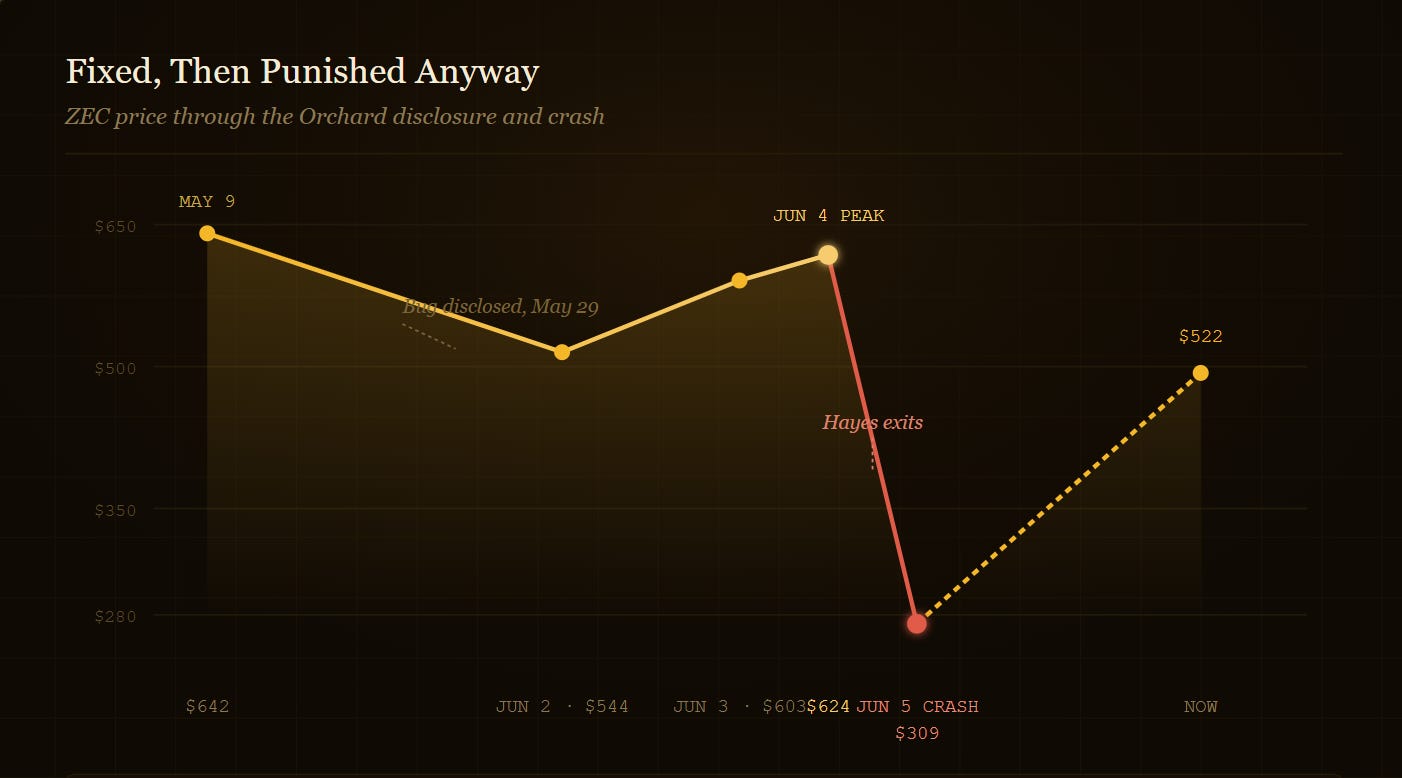
Initially, the market interpreted the hard fork as bullish. On the day the patch went online, ZEC increased by 11% and continued to rise, reaching a peak of $624 on June 4. Following Arthur Hayes's public resignation, the token plummeted, losing over $3 billion in market value and falling nearly 50% in just 48 hours to about $309 by June 5.
Peak pre-crash: $624 on June 4, the day after the fix was live.
Low point: roughly $309 to $314 by June 5, a decline of close to 50 percent in two days.
Current level: worth about $522 as of late July, up about 17% from the previous month. It was still much below the June peak, but it had truly recovered from the crash bottom.
The bug was fixed before the crash finished playing out. This wasn’t a project that was stagnating while the attackers moved, nor was it a hack that was in process or actively depleting finances. The technical issue had previously been resolved. In any case, the market sold.
Why “Fixed” ≠ “Safe”
Two terms from Shielded Labs' own disclosure - undetected and undetectable, provide the explanation. For four years, the defect remained unnoticed during production. If someone had discovered and taken advantage of it before Hornby did, there would have been no cryptographic means to identify a fake protected coin from a genuine one. No signature, no trail, nothing. Fixing the code going forward does nothing to answer the question that actually mattered to holders: was any ZEC already generated out of thin air prior to June 1, residing in someone’s wallet right now, indistinguishable from the real thing?
No matter how quickly a patch ships, it cannot address that question. Once a hack is contained, its size may be determined. There was only a four-year gap during which the answer was forever unknown, and this had no contained size. The bug was not being priced in by the market. It was pricing in the fact that certainty itself had become unrecoverable. To make matters worse, Arthur Hayes, someone a lot of the market tends to mirror, decided to leave rather than endure that uncertainty. This caused the selling to accelerate.
Not The First Time
This was not even Zcash’s only governance scare this year. Following a disagreement with Zcash’s Bootstrap board over ideas they claimed compromised the project’s development and privacy objectives, the whole Electric Coin Company development team left in January. In a single session, ZEC fell around 20%, wiping off nearly $1.6 billion in market value. The same trend emerged from two very different crises: a cryptographic flaw and a boardroom dispute. Confidence broke more quickly than any real, measurable loss would warrant.
The Existing Catalyst
Despite all of the drama, there is a genuine, current question that is worth watching closely. Since filing a Form S-3 with the SEC in November 2025, Grayscale has been pushing to transform their Zcash Trust into the first US spot privacy coin ETF, ticker ZCSH. As of July, the registration was still pending effectiveness, well after the reduced 75-day review window that authorities had implemented for spot crypto ETFs in late 2025. It would be a stretch to assert that the Orchard flaw directly caused the ruling to be delayed, and no one has confirmed this.
However, the timing is too perfect to ignore. A flaw that raised an unanswerable question about supply integrity is exactly the kind of loose thread a regulator would want fully tied off before approving the first privacy coin ETF in US history. The underlying trust has grown to hold roughly $181 million in ZEC while that decision sits unresolved. ZEC will probably be more affected than anything else in this article when the SEC really makes a decision.
Where I Land On This
Their response, not the recovery, is what strikes me as impressive. Instead of trying to covertly patch the error and hope no one notices, Shielded Labs recruited a researcher to search for precisely this kind of fatal weakness before an attacker could. And when he discovered one, they immediately reported it. In crypto, where the incentive to keep quiet is typically greater than the incentive to reveal, that is an extremely uncommon choice.
In reality, the crash teaches a lesson about privacy technologies in particular, not about Zcash's competence. The greatest advantage of a public blockchain is that everything can be verified, which is also its greatest downside. When something goes wrong inside a private pool, no one, not even the developers can definitively prove how it went wrong. This is the price of intentionally trading that checkability away. The team at Zcash did everything that a responsible team could. They were still unable to sell the market on a guarantee that the architecture itself makes structurally unfeasible.
The market did not completely abandon the privacy premise, as seen by the return to $522. It claims that the market now accurately recognises that there is a risk associated with Zcash that no patch will ever fully put to bed.
Thursday Thesis drops every week. One topic, researched properly, with an actual take. If this was useful, subscribe on Substack so you never miss an issue. Don’t forget to drop me a follow on Twitter, @solr888. See you next Thursday.