

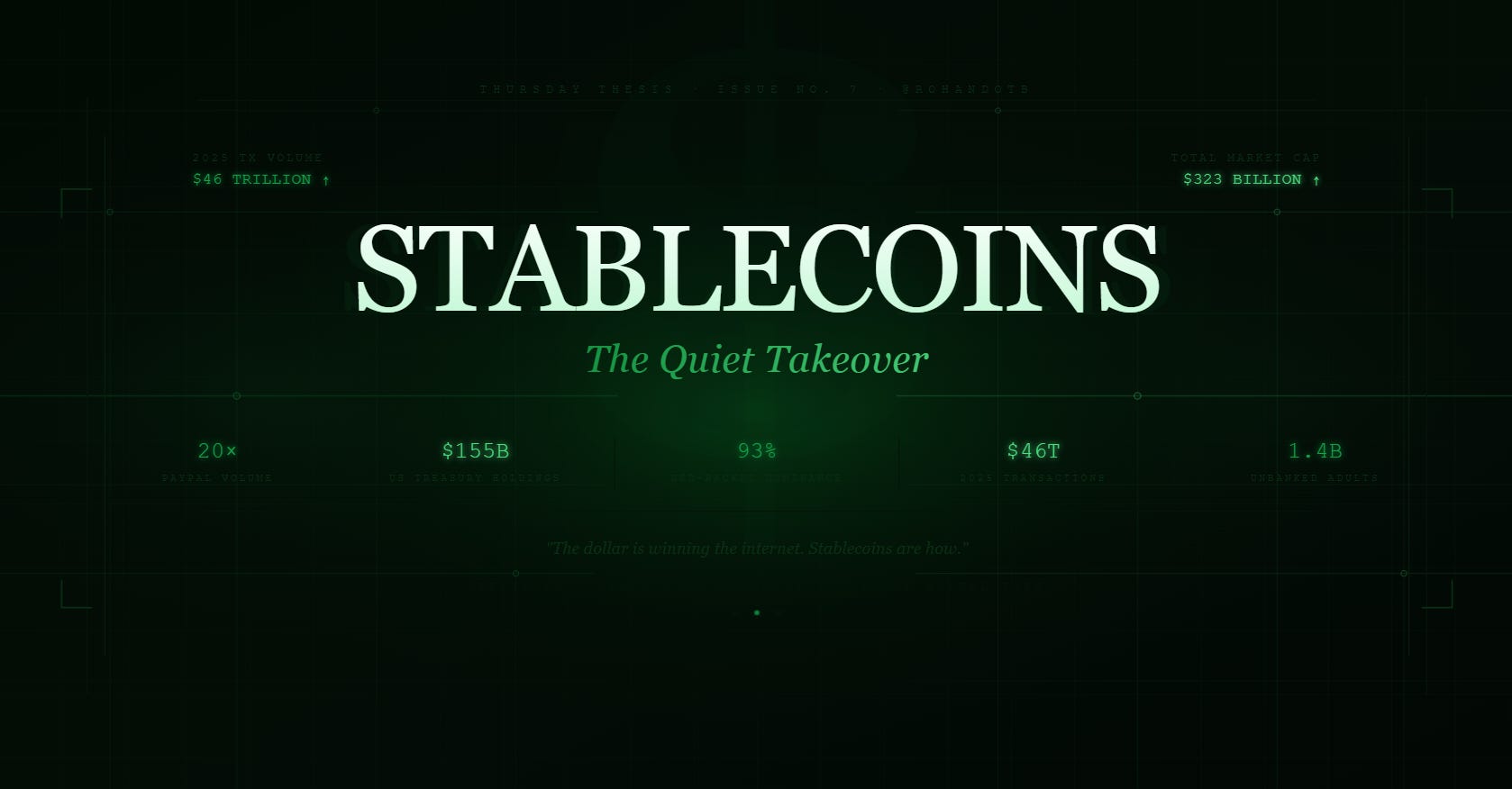
$46 Trillion.
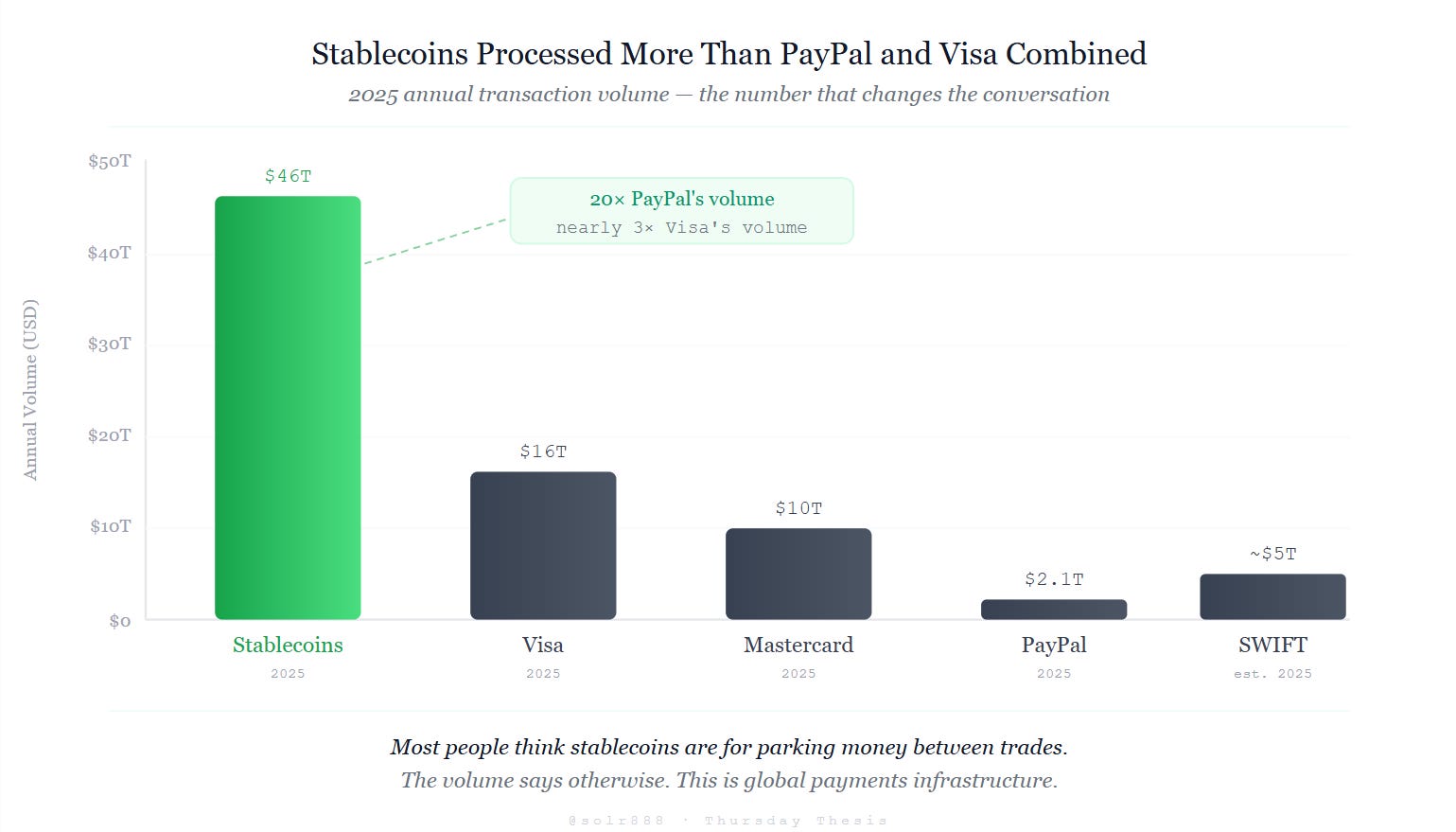
That is how many stablecoin transactions were completed in 2025. Not market value. Not total value locked in DeFi. Transaction volume: the actual movement of money across blockchains, settling payments, transfers, lending, and trades at a scale that rivals the world’s largest payment networks.
Just for context: In 2025, PayPal handled almost $2.1 trillion in payments. Every year, Visa handles over $16 trillion. Stablecoins processed more than both of them put together, despite the fact that the majority of the financial industry still views them as a cryptocurrency curiosity. All within a single year.
Even more remarkable is the monthly peak. USDT was the first stablecoin to surpass a trillion dollars in monthly volume, with an average monthly transaction volume of $703 billion in 2025 and $1.01 trillion in June. Monthly transaction volumes have increased by over ten times since the end of 2020.
This is infrastructure that has already been built, is already being used, and is already handling real economic activity at a scale that demands serious attention from anyone who wants to understand where financial systems are going.
What Are Stablecoins
They sound dull because of the name assigned to them. It evokes the idea of a digital dollar sitting quietly in a wallet. They are unremarkable but helpful for traders who wish to close positions without changing to cash.
That name is long outdated now.
A stablecoin is a blockchain-based token pegged to a reference asset, almost always the US dollar. You have a claim to one dollar of real-world reserves when you hold one dollar of USDT or USDC: US Treasury bills, cash, or cash equivalents held in custody.
The settlement and record-keeping are managed by the blockchain. The reserves are managed by the issuer.
It sounds like a straightforward structure but what it makes possible is far from simple.
Because the token is based on a blockchain, it can go anywhere in the world in a matter of seconds without the need for SWIFT intermediates, correspondent banks, business-hours limits, minimum transfer amounts, and most importantly - no authorization from any financial institution. In less than a minute, a Philippine company can pay a Colombian supplier in USDC. In Nigeria, an employee can receive their income in USDT and spend it right away without having to enter a bank account.
Compared to the current financial system, this is not a marginal improvement. It is a significant improvement for the approximately 1.4 billion adults who do not have access to banking, as well as for the billions of people who do have bank accounts but depend on costly and sluggish international transfer systems.
Businesses that are expanding upon this infrastructure have realised this. For creator pays throughout Southeast Asia and Latin America, Meta incorporates stablecoin payments. Since its introduction, Stripe's stablecoin solution has handled billions of cross-border transactions. USDC is accepted at checkout for Shopify merchants. The annualized run rate of Visa's stablecoin-linked card spending was $3.5 billion. These are not proof-of-concept tests. They are large-scale living products.
The Reserve Problem
Every dollar of stablecoin in circulation must be backed by a dollar of reserves. Short-dated US Treasury bills make up the majority of those reserves for the biggest issuers. Reserve holdings have increased in line with the stablecoin market’s growth to a total market capitalization of $323 billion.
The total amount of US Treasury notes held by stablecoin issuers by October 2025 was about $155 billion. To get a sense of that figure, look into who else has comparable amounts of Treasury bills: Japan has about $1.1 trillion. About $800 billion is held by China. About $720 billion is held by the United Kingdom. Tether and Circle, two private businesses that have grown to be systemically significant holders of US government debt through the process of creating dollar-pegged tokens, are located somewhere in the same tier as medium-sized sovereign wealth funds and central banks.
The biggest stablecoin issuer, Tether, alone has about $189 billion in outstanding USDT. Treasury notes make up a sizable chunk of its reserves. The ongoing trust in Tether's product is now somewhat but significantly linked on the US government's capacity to fund its deficit.
This is not a risk that is being widely discussed. Short-term credit markets would be affected by the Treasury bill liquidation that would occur if Tether’s trust crumbled, as it momentarily did during the Terra/LUNA crisis in 2022 when a sizable percentage of USDT holders redeemed at the same time. In their examination of the GENIUS Act, the Brookings Institution specifically noted this:
“Stablecoin issuers held approximately $155 billion in US Treasury bills by October 2025, making them collectively one of the largest holders of US government debt globally.”
The fundamental conundrum of stablecoins is this. With each new USDT or USDC issued, a dollar-denominated claim spreads throughout international financial institutions, increasing the US dollar's dominance on the world stage. However, it also develops a new systemic dependency that no one anticipated by creating a new concentration of demand for US government paper.
The GENIUS Act and What It Changed
The Guiding and Establishing National Innovation for US Stablecoins Act, or GENIUS Act, was passed by the US in July 2025 with 307 House votes and 68 Senate votes. It was the most unified financial bill in many years.
One-to-one reserve backing in high-quality liquid assets, monthly public attestations of those reserves, and yearly third-party audits are the three strict conditions set forth by the law for any stablecoin issuer participating in the US market. It established a federal licensing system that is mostly managed by the FDIC for issuers connected to banks and the OCC for issuers that are not banks. Additionally, it contained a clause that has gotten far less attention than it should: a complete ban on stablecoin issuers paying direct yield or interest to token holders.
Because it prevents stablecoins from evolving into yield-bearing securities that directly compete with bank deposits, the yield prohibition is significant.
[Section 4(c) explicitly bans any stablecoin issuer from paying direct interest or yield to holders.]
The idea was to stop stablecoins from operating outside of the deposit insurance system as unregulated shadow bank accounts. In actuality, holders receive a dollar that does not increase in value while issuers take the interest on Treasury bills from their reserves and retain it.
This is not a minor issue. With $323 billion in stablecoin supply and short-term Treasury yields of about 4–5%, the yearly interest income on such reserves comes to about $13–16 billion. Instead than going to the owners of USDT and USDC, the money goes to Tether and Circle. For issuers working within the US framework, at least, the legislation has solidified this arrangement as permanent.
The USDC vs USDT Split
Not every stablecoin issuer received the same treatment under the GENIUS Act. The most significant change in the stablecoin market that most CT accounts fail to adequately explain is the divergence it has caused between Tether's USDT and Circle's USDC.
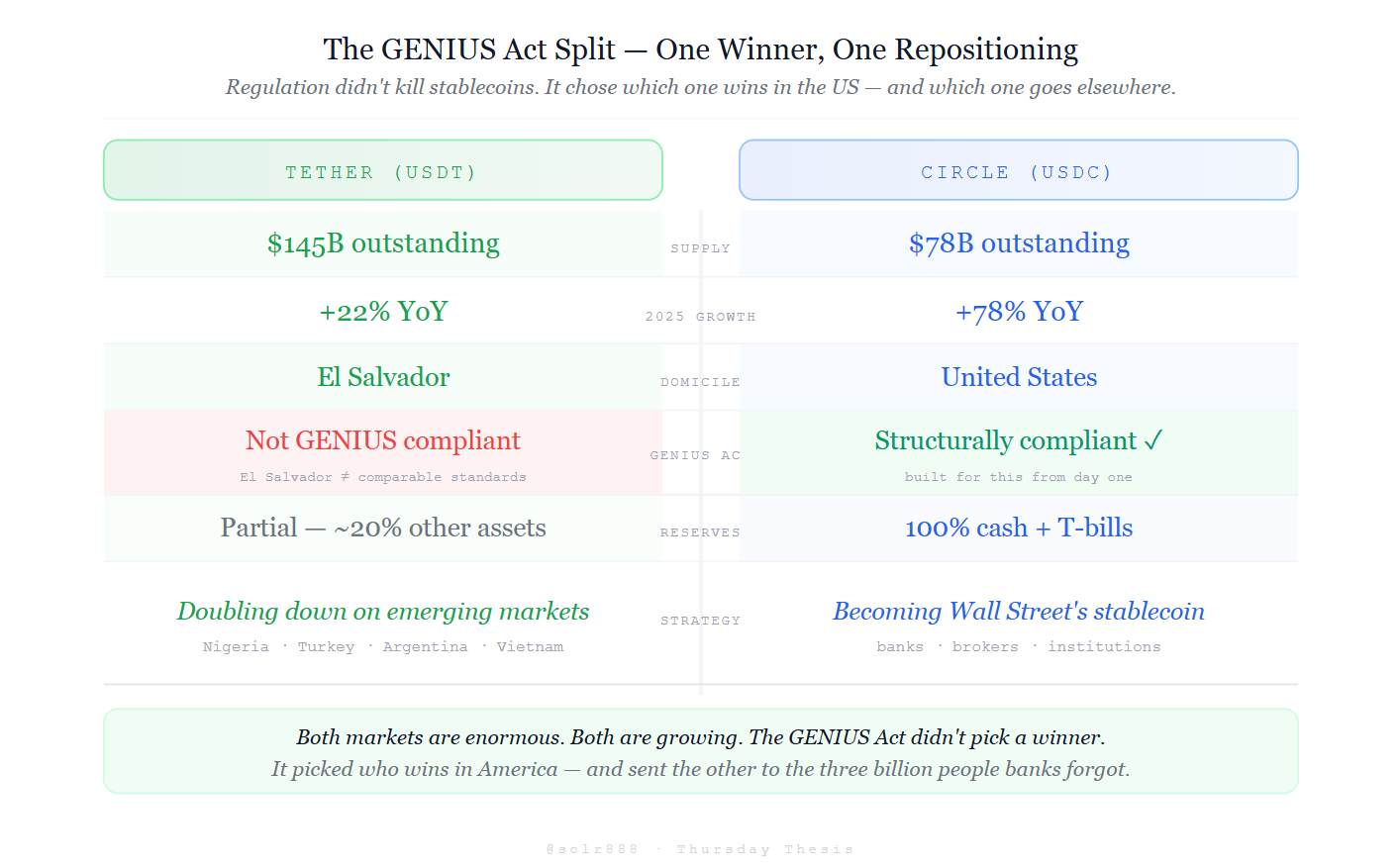
Regulatory compliance was Circle's primary competitive advantage when it founded USDC. Cash and short-dated US Treasury bonds make up its reserves. Attestations are published on a monthly basis. In Europe, it obtained an Electronic Money Institution license under MiCA. USDC was already structurally compliant when the GENIUS Act established its structure for Permitted Payment Stablecoin Issuers. All that was needed was the formal application, not an operational redesign.
As a result, USDC is now the standard stablecoin for new institutional integrations in the US. Regulated custody, broker-dealer capital eligibility, and bank partnerships. USDC is the preferred option for all major financial institutions seeking stablecoin exposure in a compliance-friendly package. By early 2026, USDC circulation had increased by 78% year over year to $78 billion.
The situation at Tether is more complex. Tether is based in El Salvador. It was not set up in accordance with the GENIUS Act framework and does not have a US domicile. According to the law, foreign issuers are only permitted to conduct business in the US if the Treasury Department certifies that their jurisdiction has "comparable" criteria; El Salvador's regulatory structure does not currently meet this requirement. USDT is not prohibited by law. However, it increases US operations' compliance costs to the point where the market might become structurally unfriendly.
As a result, Tether's USDT supply shrank by almost $3 billion in the first quarter of 2026. Its first quarterly decrease since 2022 while USDC increased by $2 billion during that time. The institutional share of the compliance-first issuer is increasing in line with the implementation of the regulatory environment.
This does not imply that USDT is dead. It indicates a repositioning of USDT. Tether is stepping up its efforts in emerging economies, which are nations with weak banking systems, the greatest demand for digital currency denominated in dollars, and the least amount of US regulation. Tether's growth markets are huge and include Nigeria, Argentina, Turkey, and Vietnam. USDT is not a cryptocurrency asset in nations where the value of the local currency is fast declining. It serves as a support system.
“The trajectory is clear: Tether is consolidating its emerging-markets dominance: payments, FX-substitute, on-ramp/off-ramp in countries with weak banking infrastructure, while ceding US institutional ground to Circle.” - Asset Whisper, May 2026
The Connection To AI Agents
I believe that the most significant indicator for the direction this market will take over the next five years is an aspect of the stablecoin story that is barely being covered by the mainstream media.
Banks are unable to supply the payment infrastructure needed by AI agents, which are programs that carry out tasks on their own, make purchases, negotiate contracts, and transfer money on behalf of people or other systems.
At every stage, banks demand human identification verification. They have business hours. They have minimal amounts for transactions. They are unable to handle $0.001 micropayments at machine speed. An AI bot cannot use a bank account to pay for an API call, rent compute time, buy data, or send money to a content producer.
Stablecoins are able to. A stablecoin transaction can be completed in less than a second. It may be as little as a fraction of a cent. There is no need for a human middleman. It is open 365 days a year, twenty-four hours a day. Stablecoins are not the only option for AI-to-AI economic interactions, which are already starting to occur and will speed significantly as autonomous systems spread. They are the only choice that genuinely operates at the necessary accuracy and speed.
This goal is specifically the foundation of Coinbase's x402 protocol, which was introduced in early 2026 and is an open standard that enables AI agents to make autonomous on-chain payments utilising stablecoins. Numerous providers of AI infrastructure have already expressed interest in integrating the protocol. It is live and running.
Nearly all of the $46 trillion stablecoin volume in 2025 was entirely human-initiated. When the AI agent economy reaches scale, it will multiply that figure by an amount that is truly hard to predict. The infrastructure has already been constructed and the consumers are being produced.
The Risks To Pay Attention To
Reserve Opacity: Tether's reserve composition is nonetheless less transparent than Circle's, even in spite of the GENIUS Act's disclosure requirements. According to Tether's most recent financial records, assets other than cash or cash equivalents, such as secured loans, Bitcoin, precious metals, and other investments, accounted for about 20% of its reserves. The short-dated Treasury bills that the majority of holders assume back their USDT are not these. This was specifically noted in the Brookings research. The liquidation period for these assets is significantly longer than for Treasury notes under a stress situation if holders wish to redeem at the same time.
Concentration Risk: Eighty-nine percent of the stablecoin market is controlled by five issuers. USDT and USDC alone make up 93%. Every protocol, exchange, and financial product that uses them as a basic layer would be affected if either failed or depegged, as was almost the case with USDT during the Terra/LUNA collapse in 2022. The stablecoin market is both more systemically significant and more regulated than it has ever been. These two trends are competing with one another.
Regulatory Breakdown: US-domiciled issuers are subject to the GENIUS Act. European ones are governed by MiCA. Major cryptocurrency jurisdictions like Singapore and the United Arab Emirates have their own frameworks. As a result, there is a patchwork of regulations that makes it difficult for international stablecoin products to comply with them and gives smart actors opportunity to engage in regulatory arbitrage. The most evident example at the moment is Tether’s shift in favor of El Salvador.
Yield Ban Effects: The GENIUS Act has established a system where the biggest holders of US Treasury bills, Tether and Circle, receive billions of dollars in interest income that holders never see since it forbids issuers from distributing yield to holders. This has already given rise to a class of yield-bearing stablecoin substitutes, the most well-known of which being Ethena's USDe, which fell 36% in early 2026 as a result of the KelpDAO exploit and related Aave liquidations. There is and will continue to be a demand for yield on digital assets denominated in dollars. Which structures will meet it without creating the systemic danger that the GENIUS Act was intended to prevent is the question.
Why The Financial World Is Watching
Since most media either overhypes or completely ignores the stablecoin story, I want to be clear about what I believe it to be.
The dollar is not being threatened by stablecoins. They are extending it. Every new USDT or USDC that is created represents an additional dollar-denominated claim that expands into areas of the world economy that are inaccessible to the current banking system. A technology that most dollar supporters did not develop and do not fully comprehend is actively reinforcing the dollar’s worldwide supremacy, which has been the focus of worried criticism for years as China and others seek alternatives.
Despite its shortcomings, the GENIUS Act has taken a calculated decision: offshore operators will control the non-compliant market while the US will regulate the issuance of compliant stablecoins. As a result of this decision, Tether continues to support the billions of people in emerging markets who require dollar access but are unable to obtain it through any regulated route, while Circle becomes the dollar's regulated digital emissary to institutional finance. Both marketplaces are very large and are constantly expanding.
It is not a coincidence that the stablecoin market crossed $323 billion while cryptocurrency markets in general moved sideways. It's a signal. Beneath all of this, a worldwide payment system denominated in dollars is being constructed, transaction by transaction, on public blockchains. This is hidden by the risky overlay of cryptocurrency, which includes memecoins, leverage, and narrative cycles.
Last year, $46 trillion was handled by that system. This year, it will process even more. Furthermore, neither the next altcoin season nor Bitcoin price targets are the main concerns of those constructing it. They are considering institutional Treasury settlement, AI agent micropayments, remittances, and cross-border payroll.
The quiet takeover that has been happening in the background for years is no longer quiet.
Thursday Thesis drops every week. One topic, researched properly, with an actual take. If this was useful, subscribe on Substack so you never miss an issue. Don’t forget to drop me a follow on Twitter, @solr888. See you next Thursday.