
Hyperliquid: The Exchange That Shouldn't Exist
A 29-year-old Harvard mathematician and a small team of ex-Hudson River Trading engineers quietly built a fully on-chain exchange that now processes more trading volume than Coinbase. This is how.


A number first.
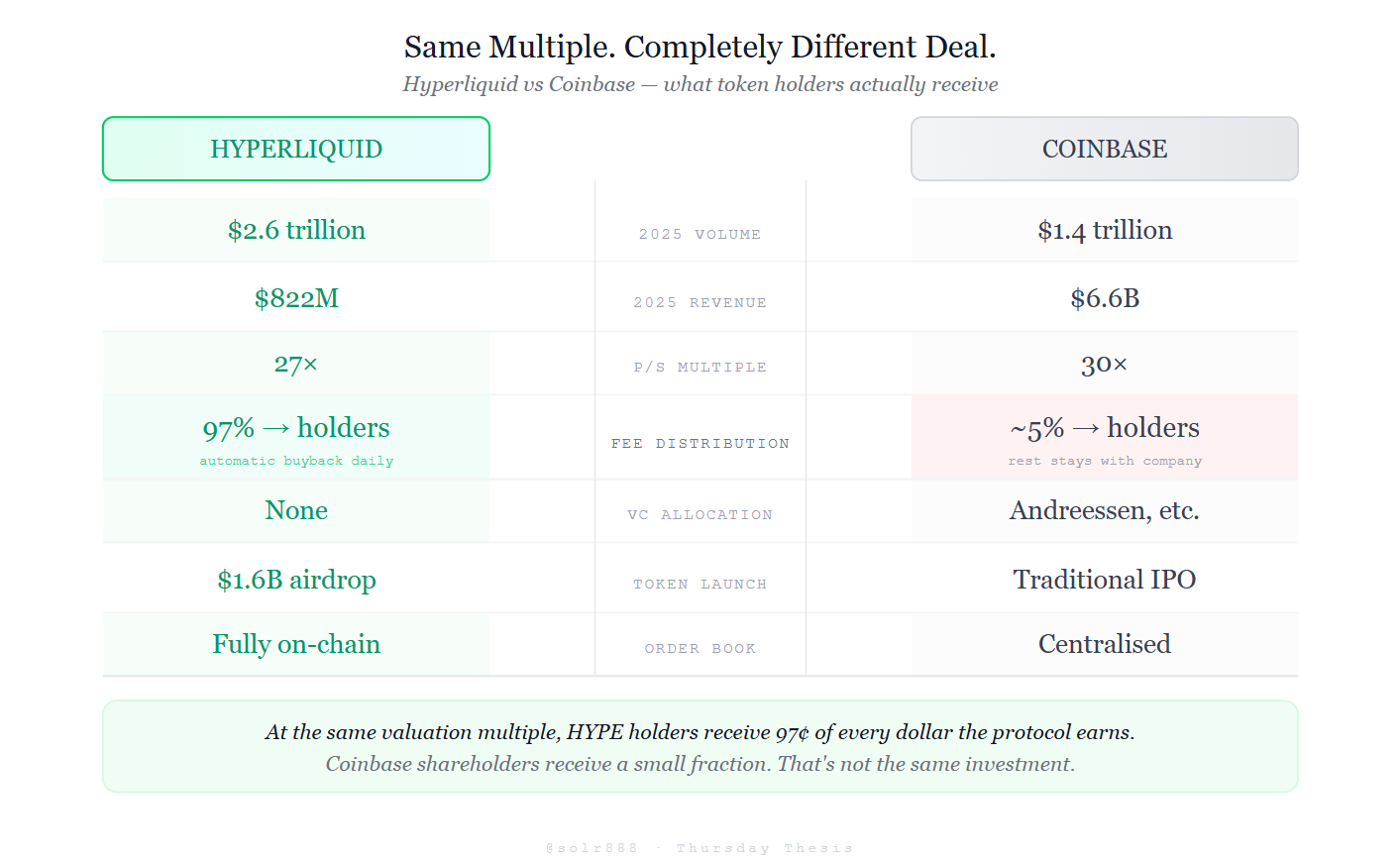
Hyperliquid achieved notional trading volume of $2.6 trillion in 2025. Coinbase, the first cryptocurrency exchange listed on Nasdaq, which has 110 million verified customers, ten years of regulatory legitimacy, and the infrastructure for Wall Street’s Bitcoin ETFs - processed $1.4 trillion.
Hyperliquid is a DEX that debuted in 2023. It has no headquarters you can point to. It has no banking license. It has never conducted a conventional advertising campaign. It launched its token in November 2024 with the biggest airdrop in cryptocurrency history, giving its users $1.6 billion in tokens. It charged nothing for the raise and retained none for VCs. And just in its second full year of operation, it nearly doubled Coinbase's trading volume.
This piece is your answer if you've been watching HYPE run and wondered if it merits serious consideration, whether it's infrastructure or narrative, long-lasting or speculative, the real thing or just another cycle story. Or at least the most truthful response I can think of.
What Is Hyperliquid?
Jeff Yan and a small group of engineers who had previously worked at Hudson River Trading, one of the most advanced quantitative trading companies in the world, created Hyperliquid, a Layer 1 blockchain, from the ground up. The founding team’s background is not in crypto. It is in applied mathematics, financial systems engineering, and high-frequency trading. That distinction matters enormously for understanding what they built.
The majority of decentralized exchanges struck a basic balance by settling the results on-chain for transparency after placing the matching engine off-chain for speed. The issue with off-chain matching is that you are entrusting the exchange with the most crucial aspect, which is who gets filled and in what order. This issue is the root of every significant DEX exploit in history.
Technically, Hyperliquid accomplished a far more difficult task. It developed HyperCore, a unique blockchain that was especially designed to operate an order book at the protocol level. With sub-second finality, each order placement, cancellation, trade execution, liquidation, and funding payout takes place on-chain in a single block. An off-chain matching engine does not exist. There isn't a crutch. The blockchain contains the whole state of every order in every market.
HyperBFT, a variation of the HotStuff Byzantine Fault Tolerant protocol used in high-performance distributed systems, is the consensus mechanism that enables this. Under ideal circumstances, HyperBFT enables validators to process transactions in parallel and only resort to a full consensus round when necessary. The result: 100,000 to 200,000 orders per second. Sub-100 millisecond execution. Zero gas fees for order placement and cancellation.
To put that in perspective, Ethereum handles between 15 and 30 transactions every second. In real-world scenarios, Solana, which is considered to be the fastest significant smart contract chain, processes between 3,000 and 4,000 transactions per second. The order throughput of Hyperliquid, which was created especially for professional trading, falls into a different category entirely.
HyperCore, which manages all trading activity, and HyperEVM, an EVM-compatible smart contract environment that operates inside the same L1 and inherits the same consensus security, make up the execution layer. Because of this combination, developers may create Ethereum-compatible smart contracts that can read and interact with real-time order book data. This is an integration that is unique to the cryptocurrency space.
The Flywheel Nobody Built Before
One mechanism is necessary to fully understand Hyperliquid's economic model: the Assistance Fund.
The Assistance Fund receives all fees collected on Hyperliquid, including financing payments, taker fees, maker fees, and liquidation penalties. 97% of the income is automatically used by the Assistance Fund to purchase HYPE tokens on the open market and take them out of circulation. Forever.
This differs structurally from all the other exchanges. Fees are retained by Coinbase as profit. Binance burns some BNB and holds onto a portion. Each centralized exchange takes wealth from its users and gives token holders just a small portion back. 97% of every dollar that Hyperliquid makes is used to purchase and burn its own token. The protocol takes nothing.
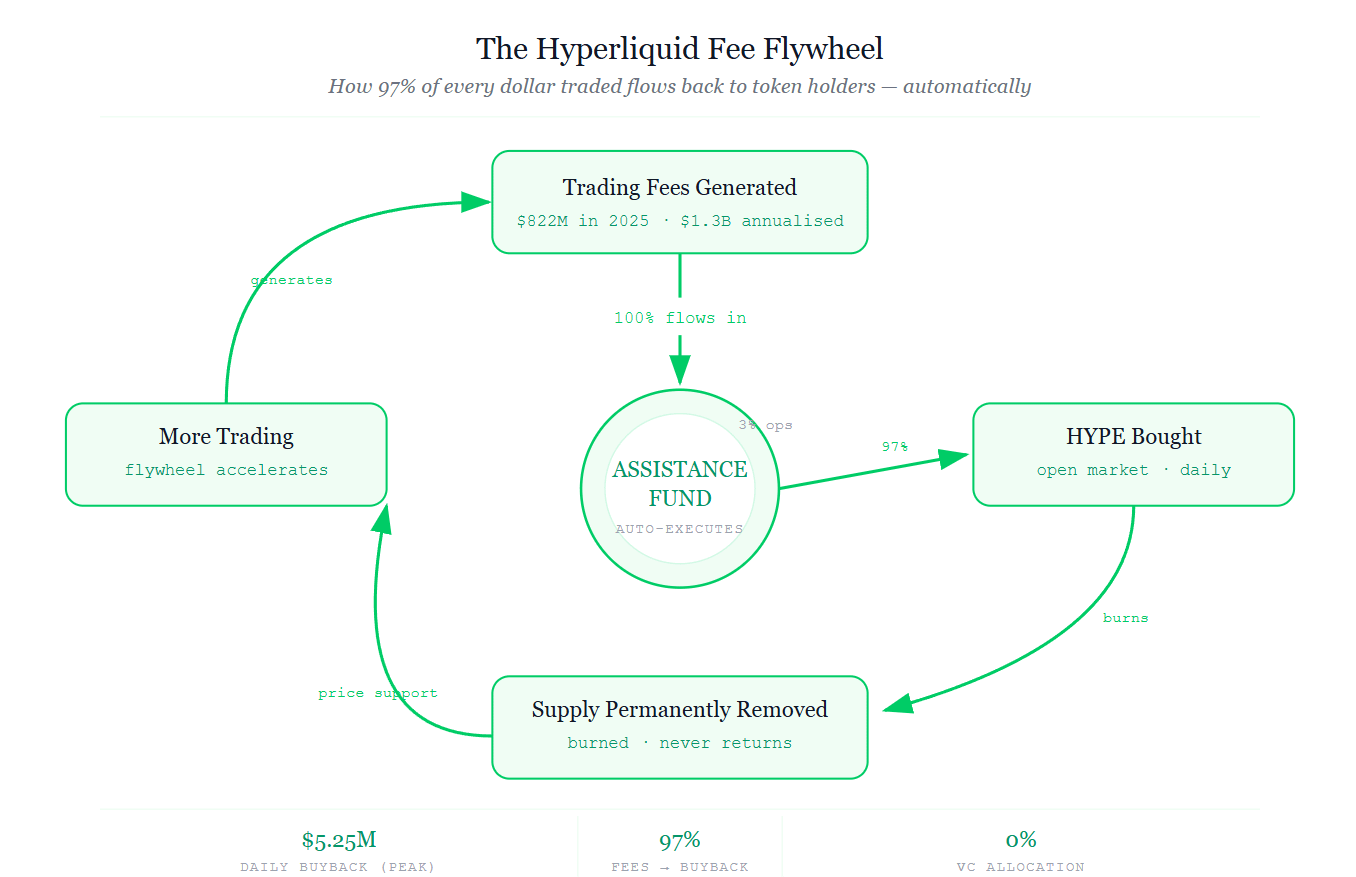
This brings in some really impressive numbers. Hyperliquid made $822 million in revenue in 2025. According to DefiLlama, annualized fees reached $1.3 billion in the first few weeks of February 2026 alone, with daily revenue peaking at $6.84 million, the highest since October. The Assistance Fund was automatically purchasing about $5.25 million worth of HYPE per day at that run rate.
This leads in what Coinbase’s institutional research desk defined as HYPE functioning “economically like a claim on exchange cashflows,” according to the research team of Hyperliquid’s rival. According to their framing, it is equity-like: token holders immediately gain more value through systematic supply elimination as the platform produces more trading activity.
With 254 million tokens in circulation, HYPE's market capitalization as of this writing is over $12 billion. $46 billion is the fully diluted valuation. HYPE trades at about the same multiple as Coinbase at 27x revenue. Where the money is spent makes a difference. In addition to employing thousands of workers, maintaining regulatory infrastructure, and running physical buildings, Coinbase offers dividends and share buybacks to its stockholders. 97% of every dollar generated by the protocol is directly and automatically claimed by HYPE holders each day, without the need for a middleman.
The SpaceX Moment
Arguably the most significant development in crypto right now. Last week, Trade.xyz launched the first pre-IPO perpetual market for SpaceX on Hyperliquid. The implied valuation surpassed $2 trillion in less than a day.
This is not a crypto story. It is a financial infrastructure story.
With a valuation of over $1.75 trillion, SpaceX is a private firm that is only available to late-stage private equity and sovereign wealth funds. Anyone on the planet with a cryptocurrency wallet can now obtain leveraged exposure to SpaceX's valuation prior to its IPO thanks to Hyperliquid's HIP-3 platform, which enables builders to permissionlessly establish perpetual markets for any underlying asset by staking 500,000 HYPE.
Within a day, Cerebras Systems, an AI chip company that went public last week, generated $280 million in pre-IPO perp volume on Hyperliquid. On the platform, it rose to the ninth most traded asset. The opening price of the shares was over twice that of its first public offering.
The pattern is starting to emerge. Hyperliquid is more than just an on-chain cryptocurrency exchange. It is constructing the framework for a parallel financial system in which any asset, including stocks, commodities, real estate, and pre-IPO private companies, can be traded without authorization, with leverage, and with complete on-chain transparency. Around-the-clock, seven days a week, without the need for a clearing house, broker, or KYC.
Earlier this year, the volume of crude oil on Hyperliquid reached $1.1 billion in a single session. The total open interest in gold and silver perpetuals has surpassed $1.1 billion. These assets aren't cryptocurrency. Currently trading on a completely decentralized protocol, they are the world's most liquid traditional financial instruments.
If you want to know why Bitwise filed for a HYPE ETF, why Arthur Hayes ranked HYPE as his top altcoin pick with a $150 price target, why Paradigm, one of the world’s most sophisticated cryptocurrency funds, is the largest institutional holder, and why Ripple Prime announced institutional DeFi access through Hyperliquid in February. it is because a small number of people have understood that this is not an exchange. It is an attempt to rebuild the global financial system on-chain.
The Numbers That Matter
Here is the data I think is most important for understanding Hyperliquid’s position right now.
Volume: $2.6 trillion in 2025, almost twice as much as Coinbase's $1.4 trillion throughout the same time frame. The 24-hour perpetual volume is approximately $3.9 billion. Early in 2026, the market for decentralized perpetuals reached $70 billion in daily volume on peak days, with Hyperliquid accounting for 30–35% of that amount.
Market Share: In the decentralized perpetuals market, almost 70% of open interest is in Hyperliquid. As of this writing, open interest is roughly $8.8 billion.
Revenue: In 2025, $822 million. Early in 2026, annualized fees reached $1.3 billion. In February 2026, daily revenue reached a peak of $6.84 million.
Airdrop: In November 2024, early users received 310 million HYPE, or 31% of the overall supply. No VC funding. Not a private sale. Only traders who had utilized the platform received the $1.6 billion in airdrop value.
Institutional Adoption: For institutional DeFi access, Ripple Prime. FIX connectivity for Gold-i MatrixNET integration. BitGo custody assistance. Institutional staking in Komainu. The Bitwise HYPE ETF application is still pending. And according to a JPMorgan study, institutional traders looking for round-the-clock access to derivatives are naturally drawn to Hyperliquid.
HyperEVM Ecosystem: By mid-2025, there were more than 8,000 smart contracts and 340,000 accounts. Within weeks after launch, Phantom Perps via Builder Codes earned $1.2 million in builder code income and $1.3 million in referral revenue. In the first quarter of 2026, almost 250 builder codes were distributed.
The Quiet Monopoly
Everybody who writes about Hyperliquid concentrates on the technology. HyperBFT. the order book on the chain. 200,000 orders every second. These are truly impressive. They are also not the reason Hyperliquid wins. Liquidity is the reason Hyperliquid prevails. Furthermore, liquidity is one of the most formidable monopolies in financial history when it is concentrated. Here is the mechanism that almost nobody is explaining clearly.
The liquidity of its order books determines the value of a derivatives exchange. Because tight spreads translate into improved execution, liquidity draws traders. More traders are drawn to better execution. Volume increases with the number of dealers. Fees increase with volume. The Assistance Fund is financed by additional fees. The Assistance Fund purchases HYPE, and as the price of HYPE increases, the procedure gains greater attention. More traders result from increased attention. The order book gets even deeper.
It is a liquidity trap, and once you are in it, it is nearly impossible to get out.
Think about the figures. More than 70% of open interest in the whole decentralized perpetuals market is held by Hyperliquid. Because of this concentration, there is effectively just one viable on-chain venue for any trader who wants meaningful size—not retail, but the funds, the prop desks, and the sophisticated participants who truly influence markets. Because the liquidity depth on rival platforms does not support it, you cannot split an order between dYdX and Hyperliquid in the same manner that you can split an order between Binance and OKX.
The NYSE, NASDAQ, and CME all constructed their moats in precisely this manner. Not by use of technology. Because of the concentration of liquidity, it became economically unfeasible for anyone who wanted to execute scale to switch to a competitor. The cost of switching when a market achieves critical mass includes slippage on each transaction you make on a thinner book in addition to the inconvenience.
The dominance of US futures markets by the CME Group is the classic financial comparison that no one is drawing. Approximately 70% of energy derivatives, 90% of equities index futures, and 85% of US interest rate futures are controlled by CME. It's not because CME's technology is superior than those of its rivals. The reason for this is that since all of the liquidity is present, all of the hedgers go there, and all of the speculators follow, deepening the liquidity and keeping everyone there. The liquidity itself is the moat.
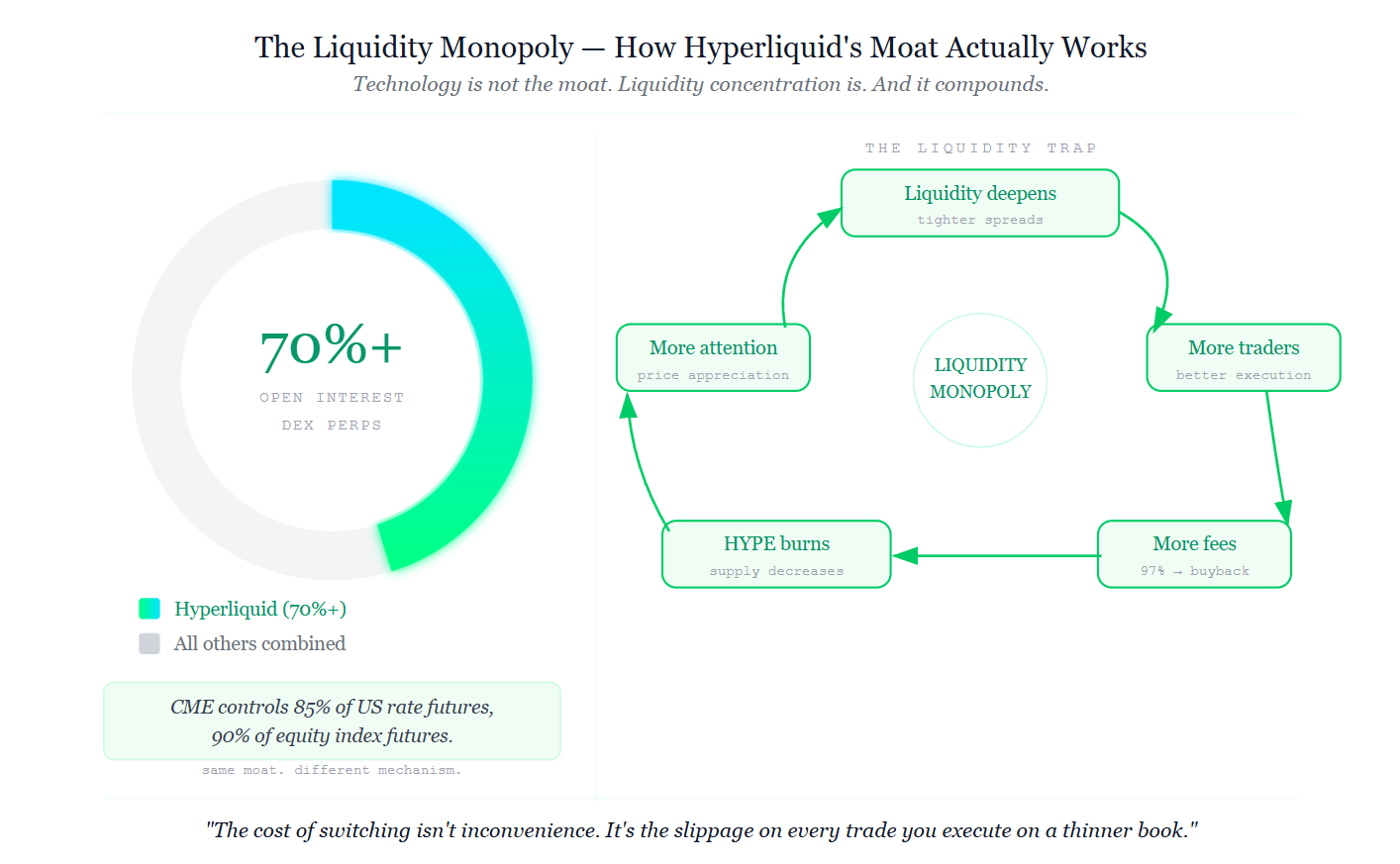
Hyperliquid is doing the same thing in on-chain derivatives. Additionally, the protocol directs 97% of the value it derives from that liquidity monopoly back to token holders, which is an additional structural advantage that CME never possessed. CME reinvests in lobbying and regulatory capture while retaining its monopolistic earnings for shareholders. Automatic daily buybacks are funded by Hyperliquid’s dominant revenues.
Whether Hyperliquid has a moat is not the question. It does, and it’s getting deeper. The question is whether the one factor that has historically dismantled financial market monopolies, regulatory intervention, arrives before the moat becomes genuinely irreversible.
My interpretation is that it won't get here quickly enough. The protocol is already too widespread, too liquid, and too helpful for any one regulatory body to significantly interfere with. Additionally, Hyperliquid will have years more to compound before coordinated worldwide regulatory action becomes feasible.
The thesis is that. Not the technology but their monopoly on liquidity.
The JELLY Incident
In March 2025, a single trader orchestrated one of the most sophisticated attacks on a DeFi protocol ever attempted.
A low-liquidity token JELLY, which is listed on Hyperliquid, was the target of the attack. The attacker manipulated the Oracle price upward by building a sizable short position on Hyperliquid and aggressively purchasing JELLY on external spot markets. The short position became unsustainable as the oracle price increased and was liquidated; however, it was sent to the HLP vault because it was too big for a typical market liquidation. With $10 million in unrealized losses and growing, the vault was suddenly holding a massive losing short.
Hyperliquid's quick and contentious reaction was to manually override the Oracle pricing and delist the JELLY market through a validator vote, resulting in a $700,000 loss for the HLP instead of the $10 million or more it was on its way to.
There were two simultaneous responses from the cryptocurrency community. First, this demonstrates that Hyperliquid is capable of market intervention. The second: Thank God they could.
Both responses were valid. The JELLY event revealed a crucial aspect of Hyperliquid that is not highlighted in its marketing: centralized intervention capabilities exist beneath the decentralized outside. Without the need for a timelock or multi-sig, a single privileged key, the oracle_updater address, can set unrestricted prices across all markets. Despite being dispersed, the validator set is small enough to allow for coordinated action. Market results can and have been overridden by the team.
Hyperliquid is neither dangerous nor fraudulent as a result. It allows Hyperliquid to be transparent about its position on the decentralization spectrum: it is far closer to the center than Ethereum or Bitcoin, but it is much further toward decentralization than any centralized exchange. The JELLY incident clarified the system's true power structure, much like the DAO breach did for Ethereum.
To their credit, Hyperliquid made significant improvements following JELLY, including dynamic open interest limitations for low-cap tokens, auto-deleveraging mechanisms, and caps on liquidation vault allocation. Compared to before the attack, the system is much stronger now. The pertinent question is whether a protocol that aspires to host international financial markets can tolerate the fundamental architectural vulnerability, which is a small group of validators with intervention capability.
The Risks That Exist
On CT, the bull case for Hyperliquid is well stated and extensively discussed. In certain aspects, the bear situation is more intriguing and receives less attention.
Token Unlock Risk: The one that Coinbase’s research desk specifically pointed out. According to the often used forward unlock timetable, unlocks will significantly steepen in 2026. Even if the company keeps doing well, future unlock flow could surpass past Assistance Fund purchases if considered at face value, resulting in further sell pressure. Although it is strong, the buyback mechanism is limited. The supply pressure turns into a first-order pricing limitation if unlocks exceed buybacks.
Buyback Ratio Compression: A discrepancy between rising take-rates and declining buyback-per-fee conversion was discovered by Coinbase's institutional research. To put it simply, Hyperliquid is charging higher costs every trade, but a smaller percentage of those fees are going to the Assistance Fund for buybacks. A portion of the stream is intercepted before it reaches token holders via builder code income, HLP vault allocations, and other fee-sharing methods. More attention should be paid to the 97% headline figure than is usually the case.
Competition: The market for DEX perp is disintegrating. dYdX is a well-known brand. With strong incentives, Aster, Lighter, and EdgeX are starting to emerge. The market as a whole has characterized the situation as "much more fragmented" in 2026 compared to 2025. On-chain venues find it difficult to replicate the structural advantages of centralized exchanges, such as Binance, OKX, and Bybit, in terms of regulatory clarity, institutional confidence, and liquidity depth.
Bridge Risk: Money needs to be bridged from Arbitrum to Hyperliquid's L1. In the past, the most attacked surface in DeFi has been bridge smart contracts. $600 million was lost on the Ronin bridge. $320 million was lost by Wormhole. Zellic and Certora have audited the HyperCore chain, but unlike Ethereum, it has not withstood ten years of testing. The attack surface is substantial at $8.8 billion in open interest.
Regulatory Exposure: Hyperliquid provides users all around the world with leveraged derivatives on stocks, commodities, and pre-IPO firms without requiring KYC. The majority of financial regulators consider this to be an unregistered derivatives exchange. The question of whether Hyperliquid's no-KYC model endures at scale is not paranoia. Rather, it is a real risk that serious investors should price as the Clarity Act moves through the US Senate and international regulatory frameworks tighten.
My Thoughts On Hyperliquid
I'll be honest about my position on this. I’m team Hyperliquid. Not carelessly nor without recognizing the risks I've mentioned earlier above and here is why.
Hyperliquid is the most technically impressive thing built in crypto since Ethereum. A fully on-chain central limit order book that processes hundreds of thousands of orders per second, with sub-second finality, and a business model that returns 97% of revenue to token holders is something that Jeff Yan and his team could not have created without a thorough understanding of both distributed computing and financial systems. The history of the Hudson River Trading is not coincidental. It is the whole explanation.
The group created something that was deemed impossible by the entire industry. An exchange-grade order book that is totally on-chain. No engine for off-chain matching. No giving in. They didn't build what the VCs instructed them to build after receiving their funding. They created what they believed in, donated $1.6 billion to their customers, and let the product do the talking.
The company is real. The income is real. There is a true volume advantage over Coinbase. The institutional interest from Paradigm, Ripple, BitGo, and Bitwise is real. And then there is the SpaceX perp. The market for crude oil. Open interest in gold and silver has surpassed $1.1 billion. Pre-IPO equity trading using a decentralized system. One market at a time, this group is methodically constructing the foundation for a parallel financial system without seeking consent from anyone.
The regulatory risk is real. The bridge risk is real. The centralisation question raised by JELLY is worth watching. I hold all of those things. However, I also believe that the people who will construct the financial system of the next twenty years will not do it by first consulting regulators and then building. The world will have no choice but to adjust to what they are going to create since it will be so blatantly beneficial, transparent, and deeply liquid. Hyperliquid is precisely accomplishing that.
I have no idea how much HYPE will be trading at in a year. No one does. What I do know is that the protocol that governs it is the most fascinating aspect of the financial infrastructure that I have researched, and the team building that goes along with it is of the highest quality that I have come across in this field.
Thursday Thesis drops every week. One topic, researched properly, with an actual take. If this was useful, subscribe on Substack so you never miss an issue. Don’t forget to drop me a follow on Twitter, @solr888. See you next Thursday.