

Ask ten different people what Ethereum is and you will get ten different answers.
It is the world computer. It is ultra-sound money. It’s a tech stock. It is an asset that yields interest. It serves as the cornerstone of decentralised apps. It’s a VC exit strategy. It is the most crucial cryptocurrency infrastructure.
At different points in time, each of these answers were accurate. The issue is that a number of them are currently in contradiction to one another, and the market is pricing in the confusion because it cannot tolerate inconsistencies.
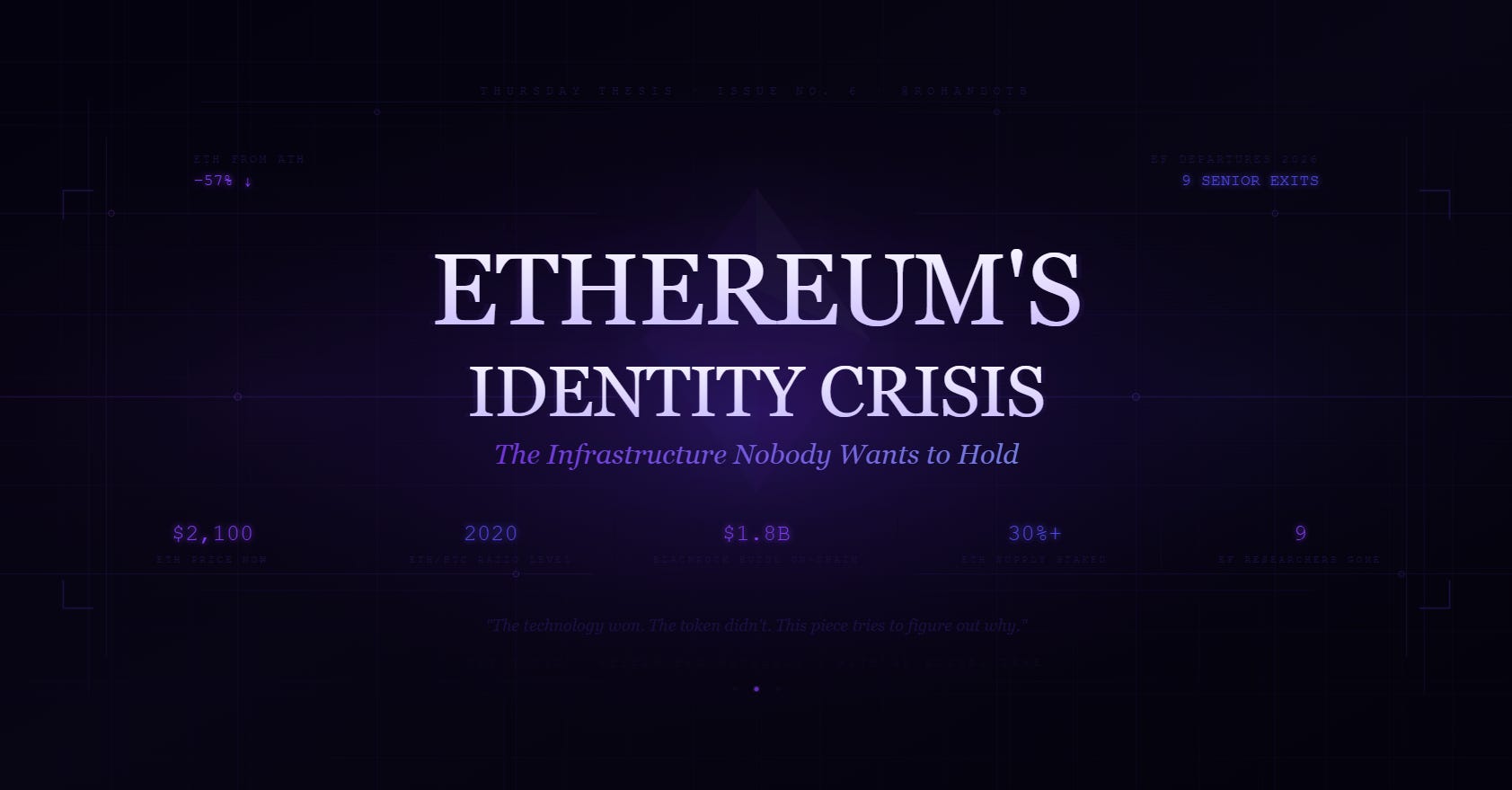
As of this writing, ETH is trading at about $2,100. $4,953 was its peak. The purest indicator of how the market values Ethereum in relation to the base asset, the ETH/BTC ratio, is at its lowest point since 2020.
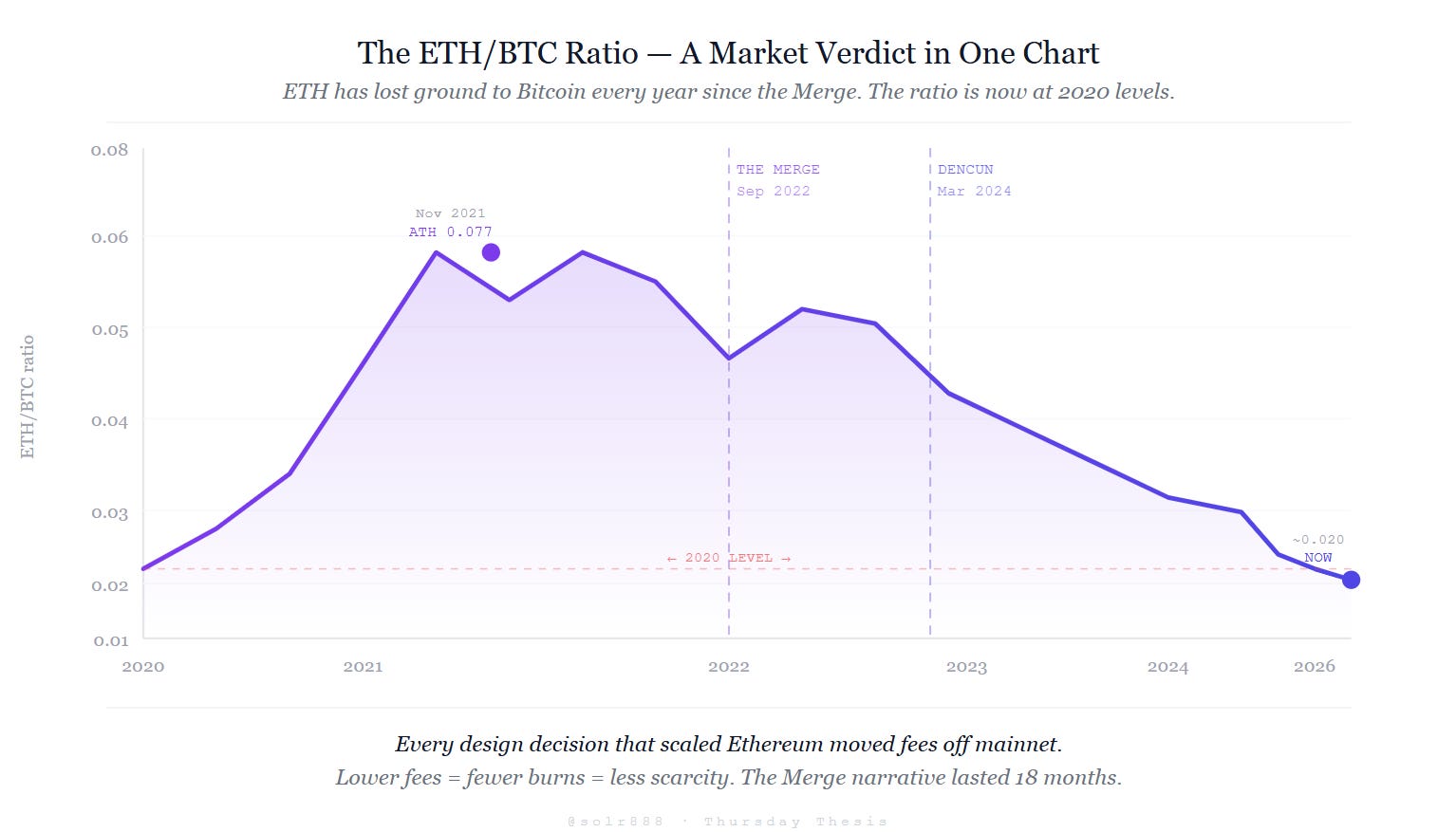
This is not a short-term decline. It's a decision. The market is making a statement. Whether it is correct is the question.
The Narrative Behind ETH
You must understand the history that led to Ethereum becoming one of the most valuable assets in the world in order to fully grasp what is currently taking place.
Ethereum switched from proof-of-work to proof-of-stake following the merger in September 2022. The engineering feat was remarkable: a live system managing hundreds of billions of dollars in value altered its basic consensus method without causing any significant disruptions. At the time, it was compared to changing an airplane's engine while it was in flight.
However, there was more to the Merge than just its engineering. Ultra-sound money was the investing narrative that accompanied it. Researcher Justin Drake came up with the theory that Ethereum's new supply model, which combines EIP-1559's fee-burning mechanism with decreased issuance from proof-of-stake, will make ETH more scarce. Even more scarce than Bitcoin, since Ethereum's supply may potentially decrease while Bitcoin's is fixed. The phrase "ultra-sound money" appeared on every Twitter account that was adjacent to Ethereum.
The thesis was truly compelling. And it seemed to be working for about eighteen months. The supply of ETH was decreasing. More ETH was being burned by fees than was being created by new issuance. In definable on-chain terms, the asset was deflationary.
Then Dencun happened.
Proto-danksharding was launched with the Dencun upgrade in March 2024, which significantly decreased the cost of data availability for Layer 2 networks. This was the correct technological choice because it significantly reduced the cost and increased user accessibility of Ethereum's L2 ecosystem. Additionally, the ultra-sound money story was unintentionally killed by this move.
Dencun moved transaction activity off the mainnet and onto rollups by lowering the cost of L2 data. Suddenly, there was significantly less activity on the mainnet, which had been burning ETH due to high gas fees. In the twelve months that followed Dencun, gas prices fell by about 95%, from a peak of 7.14 gwei per transaction to 0.50 gwei. Revenue from daily fees decreased from $23 million to $6.3 million. Additionally, EIP-1559's burn mechanism cannot counteract fresh stake issuance when fees drop below a certain threshold. ETH became inflationary again.
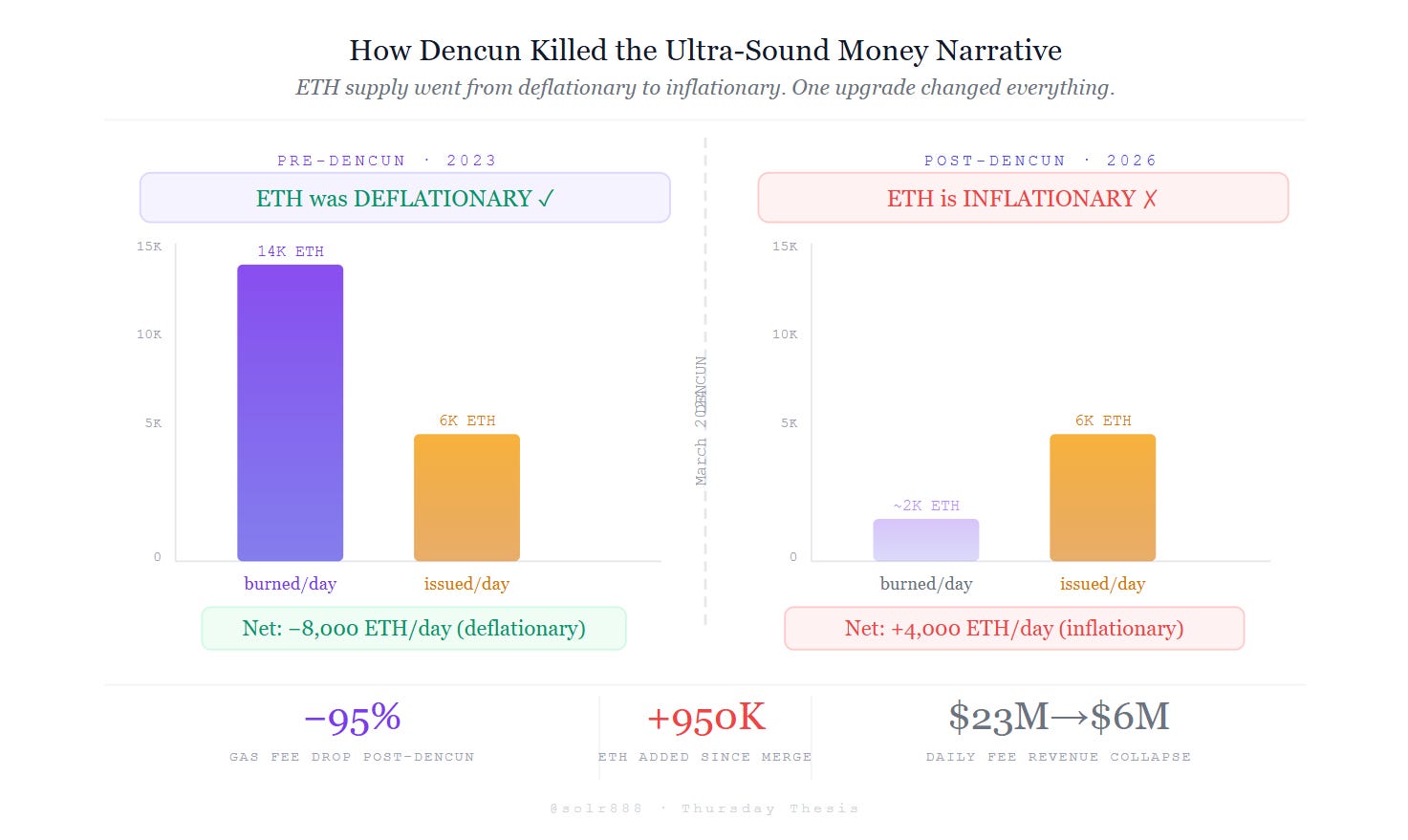
The supply that was supposed to keep shrinking has grown by roughly 950,000 ETH since the Merge. The narrative built the bull case. The story was refuted by the technical roadmap. Additionally, the roadmap’s creators failed to offer token holders a substitute concept to cling to.
“Most people don’t want to believe in something that isn’t also putting up points on the scoreboard.” - Laura Shin, journalist and long-time Ethereum observer
BTS at the Ethereum Foundation
This week has made the identity crisis impossible to ignore.
The Ethereum Foundation has experienced the largest talent drain in its history as of May 2026, with at least nine senior contributors departing this year. Every layer of the Protocol Cluster, the group in charge of coordinating Ethereum's core research and upgrades, has departed.
The significance of the list lies not only in its length but also in what it stands for. Tim Beiko oversaw the All Core Devs procedure, which is how client teams decide on material for hard fork content. Mechanism design research was headed by Barnabé Monnot. Carl Beekhuizen participated in the KZG ceremony and the Beacon Chain for seven years. Julian Ma spearheaded the Fast Confirmation Rule, which cut the L2-to-mainnet bridging time to 13 seconds, and co-authored FOCIL, the censorship-resistance mechanism. The independent financing source for Ethereum core developers, Protocol Guild, was established by Trent Van Epps. One of the ecosystem’s most recognized researchers was Dankrad Feist, who departed earlier this year.
In a single post on X, community member Banteg summed up the situation with an image of the Ethereum Foundation's organizational chart with the names of those who left stricken through. The tweet went viral because it made clear what the official announcements had been cautious to avoid saying outright: all three Protocol Cluster leads have now left.
The EF’s official response has been measured. With his 2025 reorganization, Vitalik Buterin shifted the Foundation's focus from active building to grants and research, shifting implementation to client teams and independent organizations. According to the official narrative, the departures are partially structural; researchers whose job had changed to product development discovered that the new goal was no longer appropriate. Despite the chaos, the Glamsterdam upgrade shipped on time. Geth, Nethermind, Prysm, and Lighthouse are examples of client teams that are still functioning independently.
This framing might be true. However, it is lacking. The EF has not provided a proper explanation for the departures. For a company that positions itself as the guardian of a $250 billion network, nine top departures in five months without a convincing public reason is not a typical trend. Conspiracy theories are not the cause of the community's frustration, which is strongly voiced by scholars like Dankrad Feist and pundits like Laura Shin. Demanding transparency from a non-profit whose legitimacy is essential to the ecosystem it supports is completely reasonable.
The environment itself was the source of the worst criticism. One quarter after investing $86.8 million in BlackRock's iShares Ethereum Trust ETF in Q4 2025, Harvard Management Company liquidated all of its shares by March 31, 2026. Every credible observer tracking the space highlighted the timing in light of the EF exits and the continued underperformance of ETH/BTC.
The Bear Case
What you might refer to as the trilemma of narratives is the main issue. ETH has attempted to be a financial asset, a productive asset, and an infrastructure asset all at once, and the design choices necessary to succeed at one conflict with the others.
ETH requires scarcity as a financial asset. However, the L2 scaling roadmap lowers mainnet fee burns and reintroduces inflation, despite being the best technical option for infrastructure. Deflationary supply and cheap blockspace cannot be optimised at the same time.
ETH benefits from yield as a productive asset; staking now yields 3–4% a year. However, the funding for staking yield comes from the inflationary issue of more ETH. The supply requirements of a scarce monetary asset and a productive asset are structurally incompatible.
ETH is an infrastructure asset that gains value from network activity. However, the value capture goes to the L2 tokens rather than ETH itself if that activity moves to L2s and L2s pay little fees to the L1. Together, Base, Arbitrum, Optimism, and zkSync handle a lot more transactions than the Ethereum mainnet. The infrastructure is in use but the value of that usage may not be fully captured by ETH.
Justin Drake and other Ethereum researchers have been publicly debating this criticism. Ethereum was intended to be scaled using the L2 plan. It did. However, it might have done so in a way that separated value capture from consumption, causing the basic asset to stagnate while activity increased.
The Bull Case
Ethereum is not losing. It is altering what it is. Furthermore, it might be stronger now than what it was in the past.
The ultra-sound money theory has always been based on the idea that ETH is deflationary when burns surpass issuance, which necessitates high fees and a large demand for mainnet blockspace. For a moment, that requirement was fulfilled. It is currently not being fulfilled. Nevertheless, this does not imply that the asset is broken, rather, it indicates that the narrative was based on a condition rather than a property.
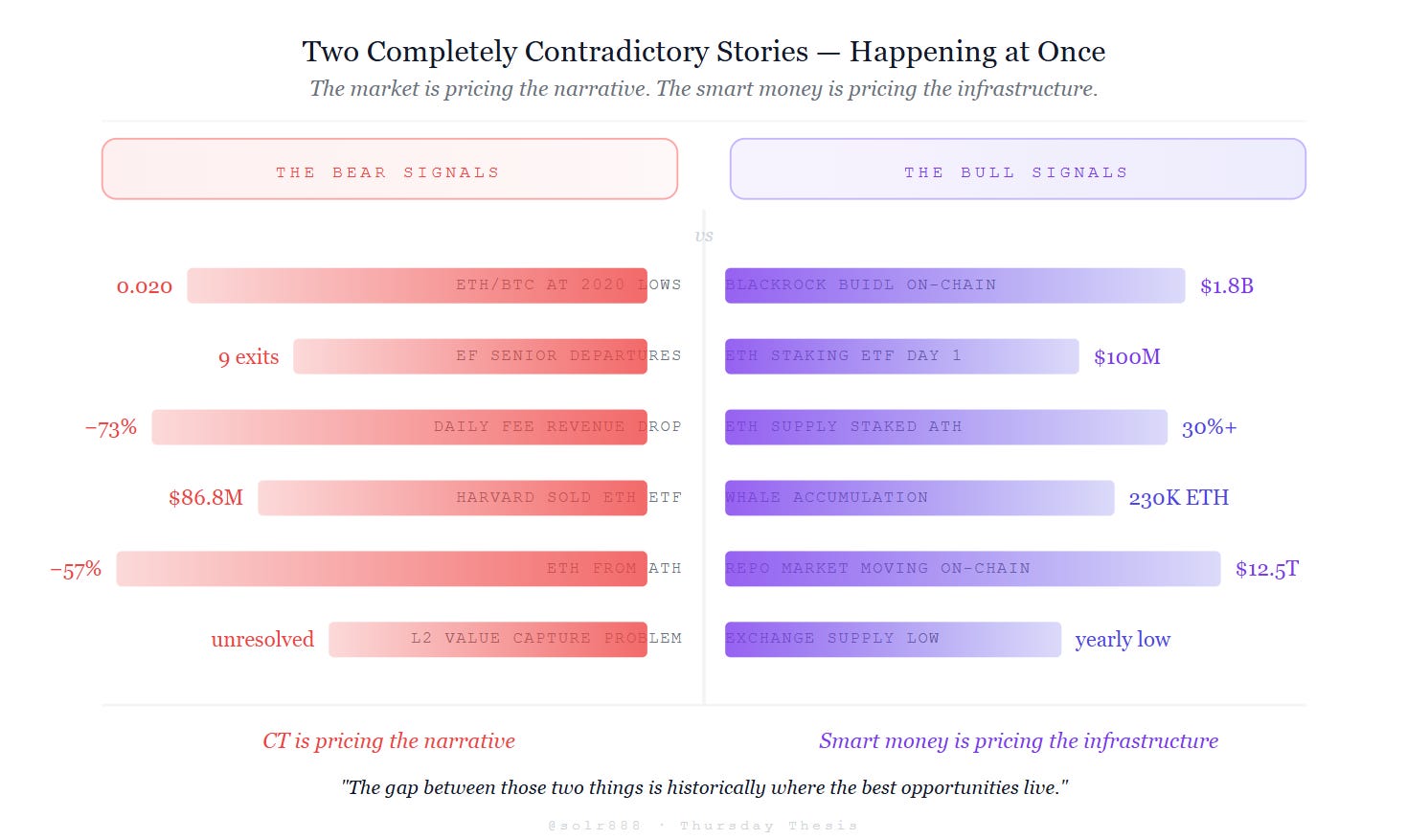
What is happening instead is something potentially more significant. The $12.5 trillion global repo market’s settlement layer, not the one for cryptocurrency traders. The BUIDL fund at BlackRock has increased to more than $1.8 billion on-chain. Live asset settlement pilots on Ethereum infrastructure have been conducted by Franklin Templeton, JPMorgan, and UBS. Parts of the $12.5 trillion global repo market’s settlement are being actively moved to Ethereum rails. These are not retail experiments. These are institutional pledges of an amount that surpasses the output of the DeFi summer of 2020.
Additionally, the actuality of staking ETFs is undervalued. The staking ETF offered by Grayscale is active on NYSE Arca. On its first day of trading, BlackRock’s staked ETH ETF attracted $100 million. Over 30% of the total ETH supply is now staked, at an all-time high. When that much supply is locked in staking, the liquid supply that can actually be sold is constrained in a way that does not show up in the headline supply number.
At current price, whales have amassed 230,000 ETH in a single accumulation window. At 14.9 million ETH, the exchange supply has dropped to an annual low. The people who actually move markets are not selling. They are buying.
The bear case is about the narrative. The bull case is about the infrastructure. Both are real. They are both genuine. Which one the market will price over the next twelve to eighteen months is the question.
The EF Departures
This is the opposing viewpoint on the Ethereum Foundation exits that, in my opinion, warrants greater attention than it is receiving.
Since 2025, Vitalik Buterin has made it clear that he wants to move execution away from the EF and farther into the ecosystem. Instead of being an active builder, the Foundation's new mandate places it as a minimalist steward. According to that line of interpretation, the departures are a result of strategy rather than a sign of malfunction. Because their work was no longer supported by the new objective, researchers whose work had shifted toward product development departed. That isn't brain drain. It is a deliberate decentralization of development.
The fact that Glamsterdam shipped on time supports rather than contradicts this theory. The development of the Ethereum protocol is carried out by several separate client teams, including Geth, Nethermind, Besu, Erigon, Prysm, Lighthouse, Teku, and Nimbus. The EF's operating budget does not provide funding for these teams. They receive funding from both independent grants and the Protocol Guild. The researchers at the EF do not create the clients that manage the network. Instead, they contribute to research and coordination.
This is not a clean story. The EF's lack of communication is still a valid shortcoming. The community has not received the level of transparency that it deserves. However, there is an operational risk: will Ethereum's updates be postponed? Will there be a network outage? The more significant and unanswered concern is the reputational risk: does this appear to institutional allocators as a governance failure?
What the ETH/BTC Ratio Indicates
The data point that requires the most genuine attention is the ETH/BTC ratio at 2020 levels.
The positive view is that ETH is cheap in comparison to Bitcoin, and as the institutional RWA story develops and staking ETF inflows mount, the ratio will mean-revert. In every prior cycle, ETH has significantly outperformed BTC in the late bull phase after underperforming it in the early recovery phase. The similar trend can stil very much apply to this cycle.
On the other hand, the ratio indicates that the market has structurally repriced ETH in relation to BTC because design decisions that put technical scalability ahead of tokenomics have weakened the investment thesis for ETH as a scarce financial asset. Even if the price of ETH increases in absolute terms, the ratio might not improve if such repricing is structural rather than cyclical.
The structural argument for ETH in 2026 is not the ultra-sound money story. That narrative is either dead or on life support as it waits for a charge increase that might or might not happen. Institutional infrastructure is the structural case. Ethereum is significantly undervalued at present levels if the $12.5 trillion repo market settles on Ethereum, if RWA issuance hits the $100 billion that many predictions suggest by 2028, and if staking ETF inflows compound at the rate indicated by the first-day BlackRock data. Not due to a lack of money. Due to institutional demands for settlement infrastructure that are not met by anyone else in terms of decentralization, security, or size.
Where I Land On This
Ethereum is not going away. From a narrative asset driven by retail to an institutional infrastructure asset, it is undergoing probably the most significant and unsettling shift in its history. This shift includes real gains that are more difficult to observe from the outside as well as real losses, such as the ultra-sound money story and the bull-market chaos cycles that retail traders adored.
The EF departures are problematic not because they pose a threat to the network's functionality. They demonstrate a governance approach that has put ideology ahead of communication at a time when the ecosystem can least afford the harm to its reputation. The Foundation needs to work on its self-explanation. Decentralisation does not equate to silence.
The L2 value capture problem is real and unresolved. Ethereum has demonstrated exceptional discipline in carrying out its technical roadmap. However, its economic strategy hasn’t been explained as clearly. As a result of that, the ETH/BTC ratio is pricing in that difference.
However, I keep returning to these points: The $12.5 trillion repo industry does not migrate to a blockchain purely based on narrative. Institutions do not invest $100 million in an ETH staking ETF because they believe in “ultra-sound money”. Additionally, the best opportunities in this asset class have historically been found in the space between what the smart money is creating and what CT is freaking out about.
Ethereum’s identity crisis is real. So is its infrastructure. The price will eventually have to decide which one matters more.
Thursday Thesis drops every week. One topic, researched properly, with an actual take. If this was useful, subscribe on Substack so you never miss an issue. Don’t forget to drop me a follow on Twitter, @solr888. See you next Thursday.